


Managing rental properties comes with a long list of responsibilities, from tenant relationships to maintenance issues. With all those tasks, staying on top of property accounting can often take a back seat, but it’s crucial for running a successful rental business. That’s why we’re tackling two critical questions for you: What is a rent roll, and why is it important?
The quick answer? A rent roll provides a snapshot of your rental income and clearly shows current and projected revenue.
Whether you’re a new or experienced landlord, REI Hub’s rent roll report simplifies income tracking. It offers clear insights on rental income, supporting better financial planning, property performance evaluation, and goal setting.
What is a rent roll?
At its most basic level, a rent roll is a report of rent payments.
In other words, rent rolls are itemized reports of income generated by a rental property or portfolio. They offer a quick view of revenue and occupancy status. Whether the report covers a single property or multiple units, rent rolls help landlords stay organized and informed.
Example Rent Roll Report and Key Elements
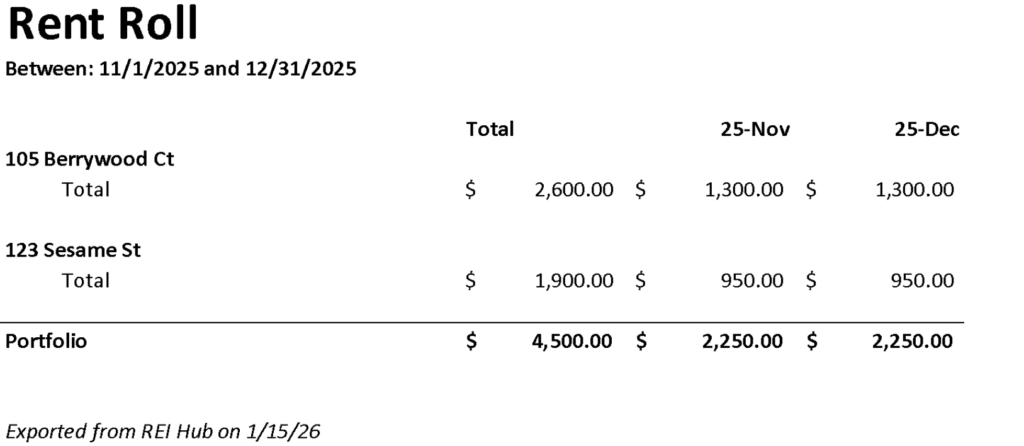
Key Elements of a Rent Roll
- Property name or address
- Unit name or number (if applicable)
- Monthly rent per unit
- Annual rent per unit
- Total monthly and annual rent for the portfolio
Some rent rolls also include details like tenant balances, additional fees owed, or lease terms.
Did you know? Rent rolls are vital for landlords of all types, whether managing residential, commercial, or mixed-use properties.
Rent Roll Benefits for New Landlords
Are you a first-time or early-stage landlord? Your rent roll will help you avoid missed income, confusion, and tax headaches. Here’s how.
1. Track Rent Payments and Missed Income
The rent payment report summarizes each tenant’s payment status. It helps you track who has paid rent, who hasn’t, and how much is owed.
This report combines all payment details to make it easier to track tenant payments and spot problems. With this information, you can quickly address payment issues, send reminders, and assess late fees.
The benefit? You’ll maintain consistent income from your rental units.
2. Prepare for Tax Reporting
Accurate income reporting is essential for avoiding issues with the IRS. Your rent roll data supports exact income reporting, simplifying tax preparation. Plus, if the IRS audits you, a rent roll can serve as supporting documentation for reported income.
Time-saving tip: REI Hub includes a built-in Schedule E report, so you can prepare your tax returns easily and confidently.
3. Resolve Tenant Questions or Disputes
Disagreements over rent owed or payment dates are common in property management. A rent roll provides a clear history of the rent charged and tenant payments. This record provides objective evidence in the event of disputes, reducing back-and-forth with tenants.
In short, the transparency you gain can help clarify misunderstandings or support eviction proceedings, if needed.
4. Understand Basic Cash Flow
A rent roll gives you real-time insights into your rental income, helping you answer a key question: Do your rents cover your expenses?
Having a clear picture of your income helps you make early budgeting decisions.
Rent Roll Benefits for Experienced Landlords
Multiproperty owners and long-term landlords can use rent rolls to support operational oversight and strategic investment decisions.
Rent Rolls for Operational and Financial Oversight
- Evaluate Property Performance
With your rent roll, you can identify rent trends and underperforming units. Analyzing rent payment reports over time helps you assess property performance and identify areas for improvement. Use information from this report for your key performance indicators to get insights into your business and answer these questions:
- Are rents increasing, decreasing, or holding steady?
- Is the property meeting income expectations?
- Should you adjust rents, change tenants, invest in updates, or consider selling?
2. Forecast for Upcoming Expenses
Use your rent roll to forecast cash flow and prepare for periods of increased expenses.
Consider questions like these: Are late payments affecting your cash reserves? Do gross rents cover operational costs and savings goals? Will any of your units need significant updates in the next six months?
With these insights, you can plan for repairs or upgrades to maintain steady revenue.
3. Plan for Lease Changes and Vacancies
By reviewing your rent roll regularly, you can anticipate income shifts from renewals or turnover. Think about how upcoming lease expirations will affect your income:
- Will the unit sit empty while you make updates and screen candidates?
- Will you renew the lease at higher rates?
Use this rental income report to make decisions about rent increases, plan for lower-income months, or adjust the budget.
This planning will prevent cash flow issues—and stress.
Rent Rolls for Strategic Investment Decisions
1. Evaluate Current and Potential Properties
Ready to sell a property? Use your rent roll to present the income history to potential buyers. It’s a critical report during valuation discussions. This information can increase buyer confidence and speed up the sale process.
Thinking about buying a rental property? The rent roll helps you evaluate gross rents and compare them to local market rates. This comparison can reveal whether the property’s rents are competitive or offer room for adjustments to improve profits.
Did you know? Lenders also use rent rolls to assess income potential. A strong rent roll, with steady revenue and occupancy, can increase your chances of securing financing for purchases or refinancing.
2. Assess Tenants and Property Managers
Rent rolls are useful for evaluating both tenants and property managers:
- Potential tenants: Candidates can provide a rent roll with proof of on-time payments to stand out and speed up the approval process.
- Current tenants: Use the report to review current tenants’ payment histories. Consistent late payments may indicate it’s time to reconsider renewing their lease.
- Property managers: High turnover rates or frequent late payments could signal issues with your property management firm, tenant screening process, or the property itself. If your current manager isn’t enforcing late fees or addressing payment problems, it may be time to find a new one.
How Rent Rolls Support Financial Reports
Rent rolls form the foundation for key financial reports, such as income statements and cash flow analyses. By summarizing rent collection data, you can manage these tasks:
- Tracking revenue trends
- Identifying budget variances or cash flow issues
- Assessing the financial health of your properties
This data helps you make informed decisions, improve your property’s performance, and run your rental property business effectively.
Generating Rent Roll Reports with REI Hub
REI Hub offers rental property owners a suite of accountant-approved tools to manage finances efficiently, including streamlined rent rolls. With our platform, you can
- Link accounts: Securely import payment data to ensure accurate reporting.
- Generate reports: Create rent rolls for any date range to review up-to-date information.
- Track expenses: Use additional features to monitor income, expenses, and property performance.
Our rent roll reports make decision-making easier, whether you’re planning for tax season or evaluating your portfolio.
Ensure Accurate Reporting with Rental Accounting Software
In addition to rent roll reports, REI Hub provides a complete bookkeeping solution tailored for landlords. We designed our platform specifically for rental property, so you have all the key features needed to keep clear, organized books:
- Ensure accuracy: Bank reconciliations confirm your accounts are complete, accurate, and reliable. With our CPA-approved reports, you can generate financial statements at the property or portfolio level.
- Save time: Our transaction feeds, transaction matching rules, mobile app, and integrations with TurboTenant and RentRedi help you work more efficiently.
- Stay confident: Our user-friendly platform streamlines bookkeeping with our simplified design—no accounting degree needed. Plus, we offer US-based support, a knowledge base, and resource articles, so you can get help when you need it.
- Stay tax-ready: Monitor depreciation and asset values with our fixed-asset tracking and depreciation tools. Cloud-based document storage and linked receipts keep your files organized and easily accessible. Tax packet exports set you up for a stress-free tax season.
All these tools are included at no extra cost, making REI Hub a budget-friendly choice for managing your rental business.
Take Control of Your Rental Finances
Landlords need rent rolls to stay organized, track income, and make informed decisions. With REI Hub’s cloud-based accounting software, managing rent rolls—and your rental finances as a whole—is simple and efficient.
Try REI Hub for free today—no credit card required! Sign up now to ensure your rental property finances are always accurate and ready for tax season.
What Is A Rent Roll FAQs
What is a rent roll in real estate?
A rent roll is an itemized report showing rent payments for a rental property or portfolio. It provides a snapshot of current and projected rental income, occupancy status, and rent amounts by unit or tenant.
Why is a rent roll important for landlords?
A rent roll helps landlords track rental income, identify missed or late payments, evaluate property performance, plan for vacancies, and make informed financial and investment decisions. It also supports tax reporting and financing needs.
What information is included in a rent roll?
A typical rent roll includes the property address, unit number, monthly and annual rent per unit, and total rental income. Some rent rolls also show tenant balances, lease terms, and additional fees owed.
How do rent rolls help with tax reporting and financial planning?
Rent rolls provide accurate income data for tax filing, including Schedule E reporting. They help landlords forecast cash flow, prepare for expenses, assess financial health, and support documentation in case of an IRS audit.